


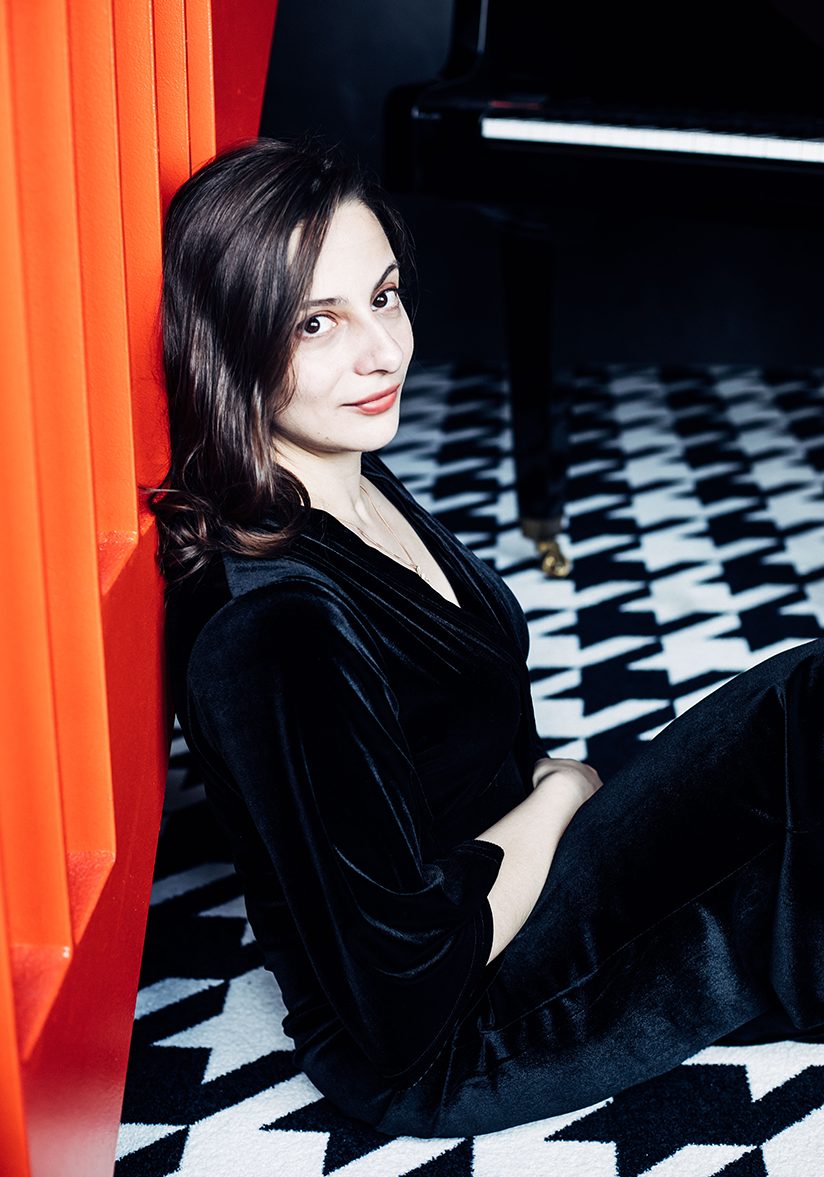
“When I play, you become the co-author. You listen to the music, but you are actually hearing your own voice, feelings, and experiences. You are the protagonist, and I am the mediator between the dream world and reality.”
Elitsa Desseva is a pianist, curator, lecturer at the mdw – University of Music and Performing Arts Vienna, and study director of the Heidelberger Frühling Liedakademie.
Recognized as one of the leading song pianists of her generation, Desseva has appeared at Wigmore Hall, Carnegie Hall, Concertgebouw Amsterdam, Musikverein Vienna, the Elbphilharmonie, Pierre Boulez Saal, Musée d’Orsay and Brucknerhaus Linz, as well as at Schubertíada, Heidelberger Frühling and the Seiji Ozawa Matsumoto Festival. Alongside her well-established partnership with baritone Mikhail Timoshenko, she has recently performed with singers including Thomas Hampson, Angelika Kirchschlager, Julian Prégardien, Feride Büyükdenktaş, Roza Herwig, Hagar Sharvit and Tia Pikija.
With Mikhail Timoshenko, Desseva came to international attention with first prizes at three of the world’s leading Lied competitions: the International Art Song Competition Stuttgart, the Franz Schubert and Modern Music Competition in Graz, and the Wigmore Hall/Independent Opera International Song Competition in London.
Her performances have been broadcast by BBC Radio 3, Radio France, SWR, NDR and NHK World Japan; she has recorded for B Records and Hänssler Classic. A particular focus is the rediscovery of neglected repertoire: her Hänssler Classic album features world-premiere recordings of songs by Eduard and Irene Erdmann. At the same time, she is closely engaged with music of the present, premiering works by Isabel Mundry, Bec Plexus, Sehyung Kim and Jüri Reinvere. In 2024, her own song Gift, after a poem by Barbara Kennedy, “captivated audiences with its unusual piano sounds” at LiedBasel Festival (Das Opernmagazin).
As a curator, Desseva develops dramaturgically conceived concert formats, including a Musée d’Orsay-inspired programme for the Académie Orsay–Royaumont; Alaverdi, a Georgian-inspired celebration for Jörg Widmann at the Heidelberger Frühling; and the semi-staged cabaret-song programme Der Tod, das muss ein Wiener sein, premiered at Stuttgart’s Renitenztheater in 2025. She also led the Lied.GESTALTUNG masterclass on Lied programming and concept development at the University of Music and Performing Arts Graz.
Since 2022, at Thomas Hampson’s invitation, Desseva has served as study director and official pianist of the Heidelberger Frühling Liedakademie, becoming the first woman in this role. She taught at Stellenbosch University’s Schubert Week in 2025 and has been a lecturer in Lied at the mdw since 2026.
An alumna of the Heidelberger Frühling Liedakademie, Académie Orsay–Royaumont, LiedBasel Academy and Carnegie Hall’s SongStudio, Desseva is a Britten Pears, Yehudi Menuhin Live Music Now and Concerto21 Young Artist, and a member of the International Hugo Wolf Academy Stuttgart.
Originally from Sofia, Bulgaria, her playing reflects a distinctive synthesis of the Russian, German and Hungarian piano schools, shaped by studies at the Hochschule für Musik Franz Liszt Weimar and the mdw – University of Music and Performing Arts Vienna.
She is currently based in Vienna.


