


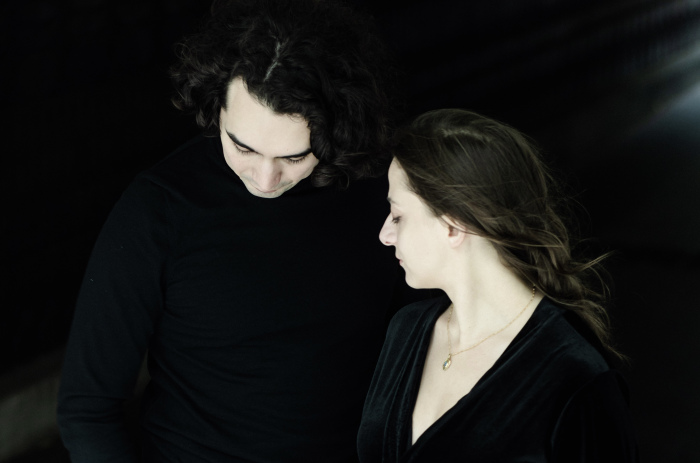

Hello, Elitsa and Mikhail! Can you remember your very first performance together?
Elitsa: Oh yes, of course. It was the first competition we entered together. I had never practised so much in my entire life. Those are pieces I could still play without any difficulty at three in the morning, even today, because I was so terrified back then (laughs).
Mikhail: I remember the preparations. We had to combine Schubert with a contemporary composer. I still remember spreading sheet music all over half of a ballet studio at the Paris Opera and wandering around among the scores, trying to decide what we wanted to perform. And that was when I realised that Elitsa was not only a fantastic pianist but also someone with an extraordinary gift for creating beautiful concert programmes.
What does it feel like to be able to share your greatest passion as a couple?
Elitsa: Well, I would perhaps say that it's better not to visit us while we're rehearsing – sometimes we're not particularly nice to each other (laughs). No, no, just kidding.
Mikhail: Everything comes from love (laughs).
Elitsa: I honestly couldn't wish for anything better. And there's something truly wonderful about being able to watch how Mischa's voice, and how he himself as a person, develops over the years. I have so much respect for the way singers actually become their own instruments. And in that sense, the person changes, the instrument changes, and everything evolves together over the years. It grows and becomes richer, and that's something incredibly beautiful. It's like watching a tree grow. I find that absolutely magical.
Mikhail: When I was still a very young singer, without much experience and barely knowing what a Lied even was, we rehearsed together for the first time. I remember this unforgettable feeling Elitsa gave me, as though I had wings on my back. I knew that wherever I went, she would always support me. She is the best pianist I've ever had the privilege of working with. I know how fortunate I am to have this privilege, and I say that not as her husband and partner, but as a singer.
Do you always share the same musical ideas when you're working on a new piece?
Elitsa: No. Oh God, absolutely not (laughs)!
Mikhail: We really argue. We fight for our interpretations, for our ideas. Of course, over the years we've learned how far we can push things, how to bring out every nuance while still finding compromises, but I remember times when we had really serious arguments.
Elitsa: I think it also has something to do with the fact that our artistic ideas and interpretations are part of who we are. You're sharing an important, intimate part of yourself. And when the other person says, "No, I really don't like that," it's naturally very difficult to deal with.
Mikhail: It hurts.
Elitsa: Of course it hurts, but I think it's also something I value enormously. I've learned so much from it. Every collaboration is a kind of relationship. In our case, that usually means the two of us on stage and the people in the audience. And in our interpretations, we try to be just as honest as we are with each other.
Mikhail, you're also very active as an opera singer. Do you prefer one of the two disciplines?
Mikhail: That's like asking, "Do you prefer your right hand or your left?" One might be stronger than the other, but both are essential parts of my body.
Opera is like a great arena for me, constantly challenging me and allowing me to grow. It's more professional than my Lied career in the sense that it's how I earn my living. But Lied needs strong support, both financially and from us as artists.
And there are fewer and fewer people in the audience who understand just how beautiful, delicate and valuable a Lied can be. I want to pass on this knowledge, this blessing. I want people to discover the hidden beauty that I myself have found in it. It's a profound passion of mine.
Elitsa: I really like the analogy with paintbrushes that Mischa sometimes uses. In Lied, you have much finer brushes, allowing you to paint an enormous amount of detail with great concentration within a small space. In opera, you have the really big brushes, with which you can create a vast landscape.
Mikhail: Exactly. And I could never say that I prefer painting with large brushes or small ones. Lied and opera benefit from each other. It's a continuous exchange, and ultimately it's all about the love of music and beauty.
Let's talk about your programme featuring Othmar Schoeck's Elegie and Robert Schumann's Dichterliebe. How did you come up with the idea of combining these two cycles?
Elitsa: I have a list of favourite songs that I absolutely want to perform with Mischa one day, and Schoeck's Elegie had been on that list for a long time.
I often feel like a dressmaker who wants to create the perfect outfit for her partner – in other words, songs that fit his voice, his personality and his emotional world beautifully.
At some point, I discovered Schoeck's cycle and immediately knew: "Oh my God, Mischa absolutely has to sing this. This is him." And it was exactly the same with Dichterliebe.
Mikhail: And then Winterthur approached us and asked whether we would like to give a recital featuring Schoeck – it really was as though all the stars had aligned.
I'm so excited about this performance, and I'm certain it won't be the only concert with this programme. I don't care if nobody proposes it again – I'll find a way to fight for it. I have a very strong intuition about this programme, and it has never let me down.
You're interweaving the two cycles rather than dedicating one half of the concert to each. What's the idea behind that?
Elitsa: We call the programme Dichterlos – "Without a Poet."
It's actually something deeply personal to us. As we said earlier, we want to be honest on stage, which means we can only express things that truly matter to us.
When we started exploring the songs and the poems, we found ourselves reflected in them.
In both cycles, the first layer is love, and how you deal with losing it. And what I find most fascinating is seeing how profoundly poets like Heine, Lenau and Eichendorff understand how to describe emotions, yet don't really know how to deal with them themselves.
The deeper we immersed ourselves in these works, the more connections we discovered between the cycles, and the more we lost ourselves, as human beings, in this story.
Mikhail: Poets find ingenious ways of combining letters and words that move people across languages and centuries. Yet as deeply as they touch others, they themselves remain just as "poetless." Perhaps they have no one who can touch them in the same way.
Other poets are more like colleagues to them, just as I, as a singer, can't listen to other singers in a completely "normal" way.
It's like the saying, "The shoemaker's children go barefoot."
That idea inspired me deeply.
Elitsa did most of the work of weaving the two cycles together into one overarching love story.
Elitsa: Nowadays, people often don't even know how to express their feelings at all, and I believe that's one of the reasons we need music and art in the first place.
As a couple, what is it like for you to perform these songs about loss and unfulfilled love? Can you really identify with those feelings?
Elitsa: Actually, we can relate to them very well. Because we're both constantly travelling, we also struggle a lot with loneliness.
Mikhail: Every time I have to leave for an opera production, it feels like a separation.
(He jumps up for a moment to attend to the pot on the stove.)
Elitsa: It's really an exception that we're sitting here so happily together now, with him cooking something. This year, we'll probably have spent only four or five weeks together. The rest of the time is pretty lonely.
As musicians, we've been conditioned since childhood to search everywhere for feelings and inspiration. And that inspiration isn't necessarily always pleasant.
Mikhail: Precisely because we appreciate so deeply what it means to have each other, we can imagine all the more vividly what it would be like to lose that.
Schoeck is one of Switzerland's greatest composers. How does it feel to perform his music in his homeland?
Mikhail: It's a great honour, and we're extremely grateful. It makes me very proud and happy. I want to dedicate my entire being, all my abilities and all my respect to this important composer.
Elitsa: Fortunately, this isn't our only performance in Switzerland. We've always experienced Swiss audiences as incredibly warm and appreciative.
Mikhail: I performed in Zurich recently. I've rarely encountered such a quiet, attentive audience. At my last performance in Winterthur, it was exactly the same. The intensity of their listening was extraordinary.
That's why I'm so excited, because I know that this beautiful programme will truly be heard. I couldn't wish for anything better.
Elitsa: We would love to create an atmosphere where we're all together, sharing this moment without thinking about the past, the future or the world outside.
And perhaps what we experience together in that concert hall will help us in our lives beyond it.

Baritone Mikhail Timoshenko and pianist Elitsa Desseva received the Eduard Erdmann Advancement Prize 2024. In its citation, the jury commended the duo’s long-standing artistic engagement and dedication to the song repertoire of composer Eduard Erdmann (1896–1958) [...]

In partnership with the Musée d’Orsay, Royaumont Abbey welcomes duos of young singers and pianists who have come to study art song and Lied [...]


